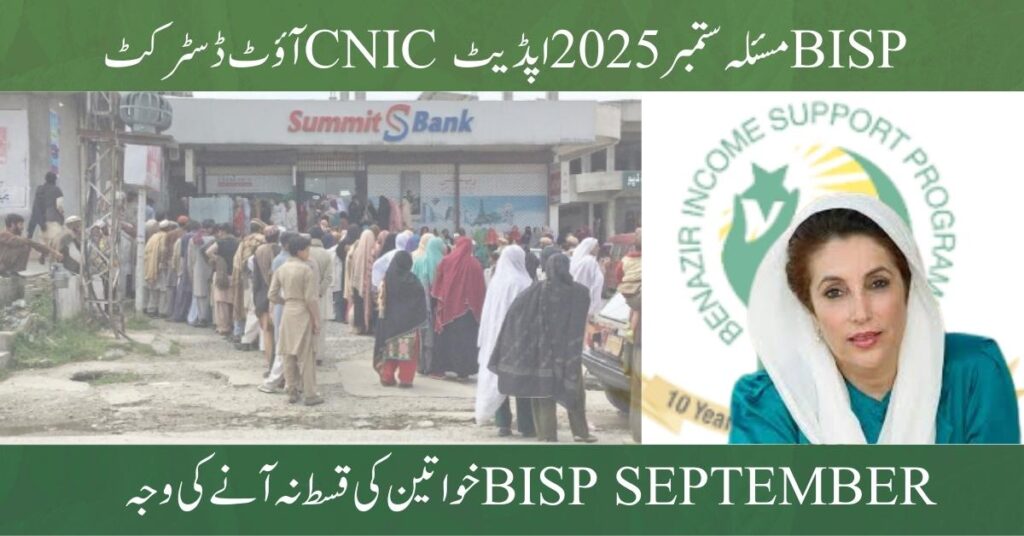
The Benazir Income Support Programme (BISP) is addressing the Out-District CNIC problem that delays payments for many women. This news-style guide explains what the tag means, the September 2025 update, how to check your status, and clear step-by-step actions to resolve a CNIC mismatch quickly.
What is the “Out-District CNIC” problem?
The Out-District CNIC tag appears when the district on a woman’s CNIC does not match the district where she now lives. BISP flags these records as Out-District, which can block or delay the quarterly payment and sometimes force beneficiaries to travel to their CNIC’s native district to collect funds.
Latest government update — September 2025
BISP teams are fixing Out-District cases district-by-district so beneficiaries eventually collect from their current city instead of the permanent CNIC district. The September 2025 Kafaalat installment remains Rs. 13,500 for eligible women; full resolution is planned across upcoming cycles though some areas still face delays.
How to check your BISP payment status
You can confirm your BISP status instantly using 8171 SMS or the 8171 web portal. Send your 13-digit CNIC to 8171 for an SMS reply, or visit the official portal and enter CNIC + captcha to see eligibility, release status, or an Out-District flag.
Method 1 — 8171 SMS
Open your phone, type only your 13-digit CNIC, and send it to 8171. Within seconds you’ll receive a reply that shows whether you are Eligible, Payment Ready, Under Review, Not Eligible, or flagged Out-District — keep the SMS as proof.
Method 2 — 8171 Web Portal
Go to the official 8171 portal, enter your CNIC and the captcha, then click Check Status. The portal shows eligibility, disbursement channel, and verification notes such as Out-District or biometric requirements — screenshot the result for follow-up.
If you are flagged Out-District — step-by-step fix
Step 1 – Confirm and save proof.
Confirm the Out-District flag on 8171 first. Save the SMS or portal screenshot with timestamp — this proof speeds complaints and follow-ups at BISP offices.
Step 2 – Visit your BISP Tehsil Office.
Go to the nearest BISP Tehsil Office with your original CNIC, the 8171 reply screenshot, and any address documents. Staff can open a complaint, start verification, or request local checks — always ask for a complaint number.
Step 3 – Update CNIC details (NADRA).
If your CNIC address is outdated or your CNIC is expired, update it through NADRA — online via PakID or by visiting a NADRA centre. Changing permanent/current address or renewing CNIC often removes Out-District blocks; bring property papers, utility bills, or FRC as proof.
Step 4 – Keep your SIM registered on your CNIC.
Make sure the mobile SIM used for 8171 alerts is registered in your name and on your CNIC. A registered SIM ensures you receive official messages and reduces fraud risk; if it’s registered to someone else, update it immediately at your mobile operator.
Step 5 – Be ready to wait while rollout completes.
BISP’s solution is applied district-by-district: urban tehsils may be updated quickly while some remote areas need one or two cycles. If your record stays blocked after NADRA and a BISP complaint, escalate using the helpline or local representatives.
Common 8171 status messages (quick table)
| Status | Meaning |
| Eligible | You qualify and will receive the installment. |
| Payment Ready | Funds released — collect with original CNIC + biometric. |
| Under Review | BISP is verifying your record; may require documents. |
| Not Eligible | Not in the program this cycle — check reasons. |
| Out-District | CNIC district ≠ current residence; requires address verification. |
Complaint & support — where to get help
If your payment is blocked, call BISP toll-free 0800-26477, email info@bisp.gov.pk, or visit the nearest Tehsil office with documents and the 8171 proof. Ask for a complaint number, keep copies, and follow up persistently — this usually speeds verification and payment release.
Practical tips (do these now)
Carry your original CNIC on visits, avoid unofficial agents who charge fees, and update your marital or current address promptly after changes. Check 8171 regularly, save screenshots, and ask community leaders for free help if paperwork is hard — many local offices assist beneficiaries.
Example
A woman living in Lahore gets an Out-District reply on 8171. She screenshots the SMS, visits the Tehsil office with a rent receipt and utility bill, files a complaint, updates her CNIC through NADRA, and collects the next released installment locally.
FAQs (short)
Q — Can I collect from any city now?
A — Not everywhere yet; BISP is enabling local collection district-by-district. Some beneficiaries will still need to collect from their CNIC’s home district this month.
Q — How much is the September 2025 installment?
A — The Kafaalat payment for eligible beneficiaries in September 2025 is Rs. 13,500.
Conclusion
The Out-District CNIC problem delays payments but is resolvable: check 8171, save proof, visit your BISP Tehsil office, update CNIC details at NADRA, and use the helpline if needed. Follow the steps above, keep records, and most beneficiaries see a smooth release of their Rs. 13,500 installment. The September 2025 Kafaalat installment remains Rs. 13,500 for eligible women; full resolution is planned across upcoming cycles though some areas still face delays. Check 8171 regularly, save screenshots, and ask community leaders for free help if paperwork is hard — many local offices assist beneficiaries.